Browsed by
Category: Broad Thoughts

Heterogeneity and Hypersensitivity in Autism: Reflection on Uta Frith’s Comments

Heterogeneity and Hypersensitivity in Autism: Reflection on Uta Frith’s Comments

About a month ago, the eminent developmental psychologist and autism cognitive researcher Uta Frith shared a number of opinions publicly in short succession.  First, Frith senior-authored (along with other scholars, including Simon Baron-Cohen as lead author) a paper defending the idea that autistic people sometimes struggle with theory of mind.  I was somewhat disappointed the paper did not more fully engage with the relevant issues, but I don’t necessarily disagree with the conclusion. However, almost immediately afterward, an interview Frith…

Read More Read More

The meaning of the double empathy problem

The meaning of the double empathy problem

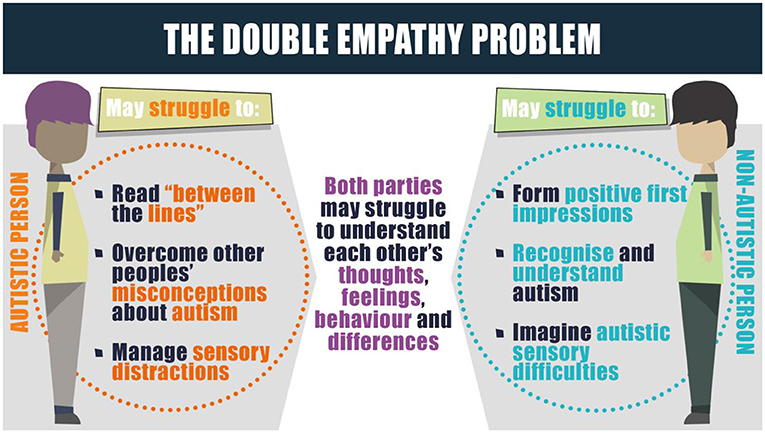
Traduction française (merci beaucoup, Autisme et Société!) Well, it’s been a while… I must confess that I haven’t written a single blog post in a few years – and haven’t posted any in a couple of years.  I got busy and distracted, and I guess the idea of writing blog posts turned gradually into a chore instead of what it was supposed to be – a nice way for me to share thoughts without going through the rigmarole of peer…

Read More Read More

Revisiting monotropism

Revisiting monotropism

The monotropism account of autism – which was introduced by Dinah Murray, Mike Lesser, and Wenn Lawson in 2005 – is, within the autistic adult community, probably the dominant theoretical approach towards understanding what autism is.  Many autistic people – myself included – find monotropism to be quite a bit more consistent with our personal experiences than other theories of autism.  I suspect this might have something to do with the fact that the monotropism account was developed by autistic…

Read More Read More

Supports, Burdensomeness, and Dependence

Supports, Burdensomeness, and Dependence

Research suggests that volunteering and helping others can be beneficial for the mental health of the helper.  This effect is believed to stand above and beyond any tendency for those with better mental health to be more likely to volunteer for things in the first place. Conversely, dependence on others and being a recipient of help can be bad for mental health.  Indeed, a major component of the dominant interpersonal theory of suicide suggests that those who perceive themselves as…

Read More Read More

Autism and Asperger’s in the Nazi Era

Autism and Asperger’s in the Nazi Era

In the last couple of years, the autism world has witnessed a very intense debate regarding the historical origins of the neurotype we study.  Traditionally, Hans Asperger – one of the first people if not the first to use the term autism in its modern diagnostic sense, and the man after whom “Asperger syndrome” was named – was thought to be an essentially benevolent figure within the murderous Nazi state, which had embarked on a policy aimed at slaughtering disabled…

Read More Read More

On Neurodiversity: Part III: What is the Neurodiversity Paradigm?

On Neurodiversity: Part III: What is the Neurodiversity Paradigm?

Author’s Note: I no longer particularly like some of the ideas in the post, which I now think are a bit oversimplified. If you want an updated take on my view of neurodiversity, I wrote an article at https://doi.org/10.1159/000523723. In Part II of this series, I discussed a lot of the basic ideas that still motivate my approach to neurodiversity.  I argued that we presently lack a clear, consistent definition of neurodiversity, and I illustrated how this ambiguity hinders our…

Read More Read More

Disability, Discrimination, and Politics

Disability, Discrimination, and Politics

Here’s a fundamental question: what is the political status of autism?  Are autism and other disabilities simply impairments that need to be addressed through the provisions of services and supports, or are autistic people also victims of oppressive social and political systems that cause marginalization?  Do autistic people just need charity, or do we need social justice as well? We need to address this question and answer it, for I would say that the present model used to address autism…

Read More Read More

Deficit Isn’t a One-Way Street

Deficit Isn’t a One-Way Street

Sometimes, the best way to see where our conventional assumptions can go wrong is to consider concrete examples. Within the pathology paradigm, we assume that autistic people are disordered, that they have deficits in different skills and abilities, but we don’t critically examine how autistic people’s environments and the typically-developing people within these environments might contribute to autistic people’s disabilities.  We ignore the possibility that the typically-developing person might be something less than a normative ideal of perfection. Autism and…

Read More Read More

The Philosophical Roots of Neurodiversity

The Philosophical Roots of Neurodiversity

I can be a bit of a theory nerd, sometimes.  I like considering how different systems of thought develop in relation to one another. One of these theoretical questions that interests me is the emergence of the neurodiversity paradigm.  This idea, developed by Judy Singer in the late 1990s, is a radical departure from most of previous human thought.  The neurodiversity paradigm portrays the diversity of individual human minds and brains as something to be valued, whereas most human societies…

Read More Read More

Neurodiversity and “Levels of Functioning”

Neurodiversity and “Levels of Functioning”

Many people seem to have adopted a curious middle-ground in the neurodiversity debate: many of us will readily concede that so-called “high-functioning” autistic people should be considered within the neurodiversity paradigm, but will still argue that the pathology paradigm should be applied to so-called “low-functioning” people.  We’ll concede that “high-functioning” autistics represent a valuable form of human diversity and that they should be accepted for who they are, but we’ll keep looking for a “cure” to so-called “low-functioning” autism. I…

Read More Read More